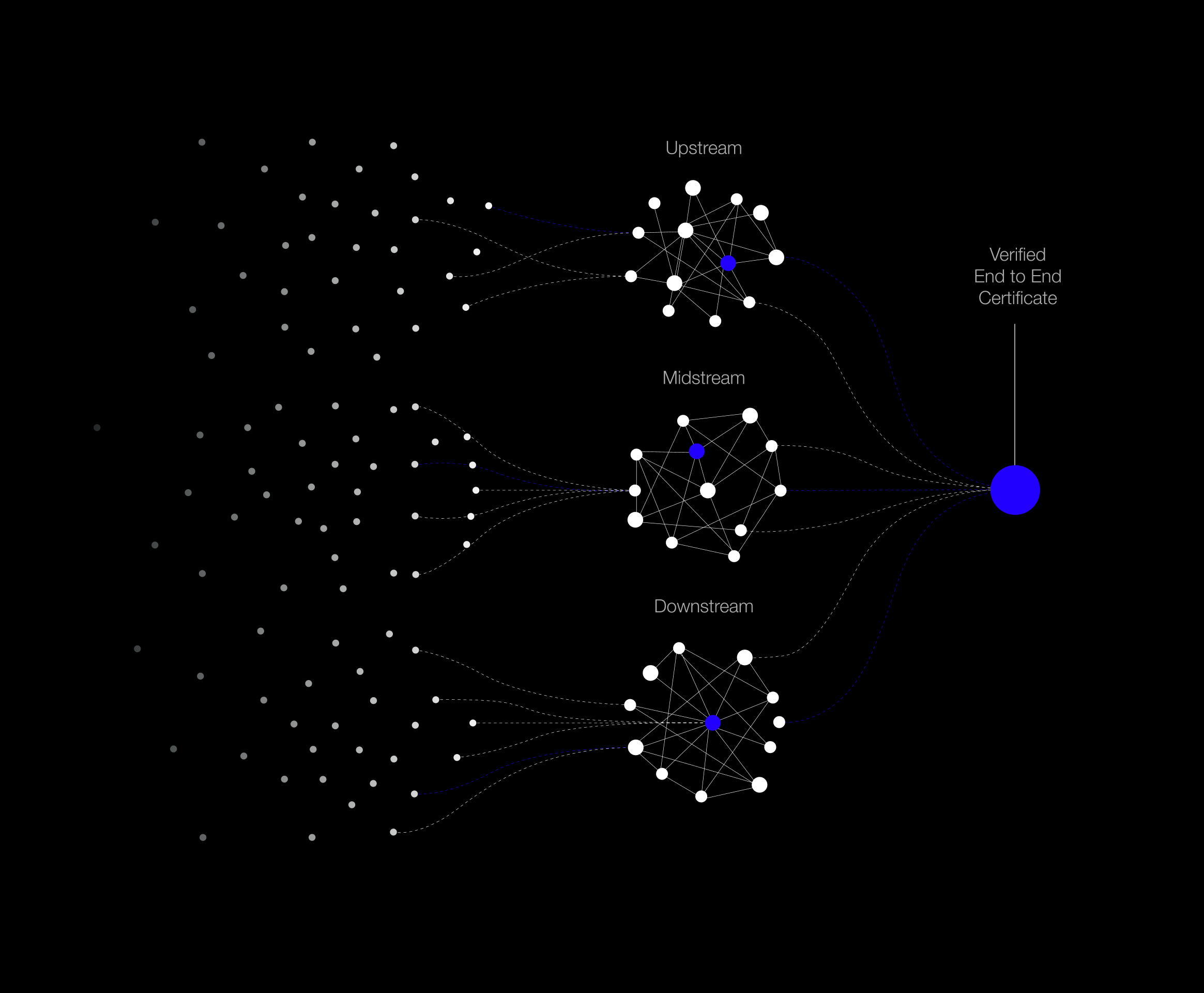
Context Labs enables the verification of emissions intensity and production of environmental attributes.
Context Labs combines deep data infrastructure with real-time, AI-driven measurement and independent third-party verification. Unlike approaches that rely on periodic audits and static datasets, Context Labs enables continuous, traceable, and scalable certification.
The platform enables a certificate to be issued under an established methodology, life cycle assessment (LCA), or recognised framework, and independent verifiers confirm the calculations, so the certificate is traceable, auditable, and commercially usable.
Context is the difference between an estimate and evidence.
How it works
Built for the complete picture: from raw inputs to verifiable proof
Context Labs enables digital certification on a single platform, spanning standards, methodologies, and commodity supply chains. It operates within accreditation frameworks set by independent, government-recognized bodies.
Context Labs is the only platform that delivers both Book & Claim and Trace & Claim in a single solution, giving customers the flexibility to capture commercial opportunity now and the traceability to meet stricter requirements as they arrive.
Benchmark
How Context Labs compares:
today, and against EUMR & CBAM from 2026+.
Emerging Regulatory Requirements
Two major regulations targeting emissions monitoring for industrial products are coming into force in Europe: the EU Methane Regulation (EUMR) and the Carbon Border Adjustment Mechanism (CBAM). Key requirements of EUMR and CBAM are laid out in the table below. [3] The continuous, asset-level data capabilities provided by Context Labs meet or exceed all of these requirements.
[2] Regulation (EU) 2024/1787 on methane emissions in the energy sector; European Commission import requirements guidance. [3] Carbon Border Adjustment Mechanism, Regulation (EU) 2023/956, definitive regime; European Commission CBAM guidance for installation operators outside the EU. CBAM currently applies to iron and steel, aluminum, cement, fertilizers, electricity, and hydrogen; natural gas and LNG are not directly covered, though gas is a significant input to several of these sectors.
Typical compliance approaches in the energy industry differ across several dimensions.
Applicable to every side of the table
COMMERCIAL
Buyers & Traders
- Receive certificates traceable to source data
- Use in procurement workflows and buyer proof requirements
SUPPLY
Producers & Exporters
- Turn operational data into certified outputs without manual work
- Build a verified emissions profile that differentiates product and supports commercial transactions
- Extend automatically as regulatory requirements change
- Automatem and repeat at scale across sites and operators
GOVERNANCE
Regulators & Policymakers
- Aligned with established reporting frameworks across jurisdictions
- Structured to support independent third-party review of every claim and calculation
- Backed by auditable evidence for every claim
AUDIT
Verification & Assurance Partners
- Full auditable lineage available for third-party review
- Component/composite architecture supports segment-level audit
FINANCE
CFO & Treasury
- Verified carbon intensity data can affect the cost of capital
- Context converts data into basis points
TECHNOLOGY
CIO & CTO
- Azure-based architecture
- Immutable ledger
- Trust travels with the data
Partnerships & Customers





From Claim to Evidence:
A Guide to Emissions Certification
Walk through a real natural gas pathway: how the certificate is built, how it holds up against 2027 EUMR and CBAM requirements, and who verifies the numbers. Fill out the form and access the Guide.
News
May 08, 2026
Context Labs Referenced in IEA Global Methane Tracker 2026
Context Labs is referenced in the International Energy Agency’s (IEA) Global Methane Tracker 2026 report, within the chapter “Addressing Methane in the Marketplace” […]
Apr 29, 2026
From the Eurogas Methane Emissions Conference: What Comes Next for EU Compliance
This month at the Eurogas Methane Emissions Conference in Brussels, there was much discussion about the upcoming EU Methane Regulation, particularly through the lens of the current geopolitical space […]