On the Future of Talent & AI: Humans Will Always Rule
Across this commencement season, audiences have booed executives who took the stage to talk about AI. In a time of facing talent uncertainty, an impending AI revolution, we take a look at what we’re really doing here. The argument is quite simple: humanity.
A single human brain operates on twelve to twenty watts. A large AI data center consumes hundreds of megawatts. The asymmetry is the entire conversation. Raw computational power is not cognition. It is a substrate.
The World Is Not the Internet
Frontier models are trained largely on data scraped from the Internet. That dataset is a scratch on the surface of human knowledge, a small fraction of all recorded and accessible information, an even smaller fraction of humanity’s collective wisdom. The Internet is not the world. It is a thin, mostly recent, mostly textual projection of it.
The deeper realm sits elsewhere. It lives in craft, in oral traditions, in the body of practice that engineers, doctors, farmers, and artists carry without writing down. It lives in what Carl Jung called the collective unconscious, the inherited reservoir of archetypes that has shaped human experience across millennia.
“The collective unconscious contains the whole spiritual heritage of mankind’s evolution, born anew in the brain structure of every individual.”
— C.G. Jung, The Structure of the Psyche
A transformer can only compress what has already been written down and made machine-readable. AI can never fully ingest or replicate this profound, intuitive, and symbolic realm.
This is why humans will always rule AI.
The public conversation about AI keeps returning to substitution. Who will be replaced. Which jobs will disappear. The framing misses where the real value sits.
Close to the Edge
Modern quantum physics offers a useful idea: the event horizon. It is the boundary beyond which the rules we know break down and new possibility emerges. Innovation lives there. So does meaning.
AI is very good at the well-mapped center of any field. It compresses what is already known, already labeled, already public. The center is becoming commoditized and cheapened. This is the nature of next gen Moore’s Law growth in the AI age.
However, the edge is becoming more valuable. The edge is where ontologies have not yet formed, where context has not yet been recorded, where judgment has to be made under uncertainty, where ideas from different disciplines collide. AI cannot disintermediate the human capacity to sense and connect ideas across domains. That capacity is the source of every real breakthrough, and it sits at the edge.
Jung saw this from another angle.
“The meeting of two personalities is like the contact of two chemical substances: if there is any reaction, both are transformed.”
— C.G. Jung, Modern Man in Search of a Soul
Innovation is the same reaction at a larger scale, across people, fields, and traditions. AI participates in that reaction. It does not initiate it.
Talent Lives at the Edge
The same logic applies to people. AI compresses the well-mapped center of any field first. A career narrowed to a single specialty sits exactly where the compression begins. The talent that appreciates in this era is the opposite shape: wide event horizons, interdisciplinary instincts, and the capacity to work across cultures and domains.
These are the people who carry context, provenance, and judgment from one part of an organization to another. They are also the people AI cannot stand in for, because their value sits in the connective tissue between fields, where no single discipline contains it.
Humans Rule AI
The public conversation about AI keeps returning to substitution. Who will be replaced. Which jobs will disappear. The framing misses where the real value sits. Every useful AI system depends on judgment that came from somewhere, and that somewhere is talent working upstream, often invisibly, deciding what counts as true, what counts as relevant, what counts as worth doing. Context actually rules AI, without it, AI has no waypoints.
That role does not shrink as AI grows. It expands. The cheaper cognition becomes, the more valuable the upstream work of context, trust, and purpose becomes. A model can write a paragraph. It cannot decide whether the paragraph should exist. A model can optimize a process. It cannot decide whether the process serves a worthy cause.
Humans rule AI by staying upstream of it. As the source of context. As the keepers of provenance. As the carriers of judgment. As the authors of cause. Done well, the AI era makes the upstream work of meaning, wisdom, and trust more consequential than it has ever been. That should be the aim.
Twenty watts in every human being is powerful. Its power is what guides and structures AI. The AI hype factor increasingly leaves out this key fact. What humans build with AI, with our unique embedded DNA’s wisdom, spirit, and soul, are the questions that will continue to make the difference. This is why we cannot lose our way. This is why Humans will always rule AI.
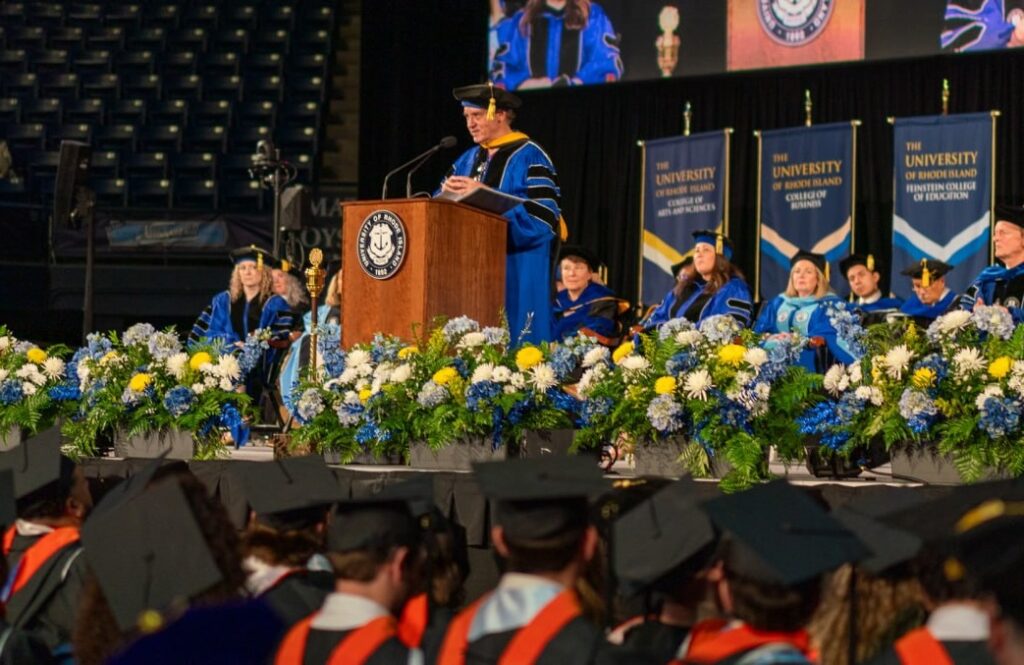
This essay is adapted from the commencement speech delivered at the University of Rhode Island’s College of Engineering on May 16, 2026, where Dan Harple was awarded an Honorary Doctorate of Science.
Watch the full commencement speech
Related
Mar 2, 2026
White Paper: Without Context, AI Doesn’t Work by CEO and Founder Dan Harple
If AI is going to power real-world systems — energy, capital markets, supply chains, regulatory infrastructure — trusted data becomes an operational requirement. The most important data is data about the world. […]
Sep 24, 2025
Reimagining Emissions Transparency in the Energy Supply Chain
The global energy sector is at a turning point where emissions transparency is no longer of secondary concern, but a central driver of competitive commercial advantage and operational integrity. […]