Context Labs has been cited in a new white paper at The University of Texas at Austin titled Next Steps for the EU Methane Regulation: Implications for U.S. and Global Gas Suppliers, authored by Ben Cahill and affiliated with the Center for Energy and Environmental Systems Analysis (CEESA) at the Cockrell School of Engineering.
The white paper examines key aspects of the European Union’s Methane Emissions Regulation, including producer-level emissions reporting and traceability across complex supply chains. In the section on producer-level emissions and traceability, charts sourced from Context Labs are used to illustrate different compliance pathways for reporting emissions data under the regulation.
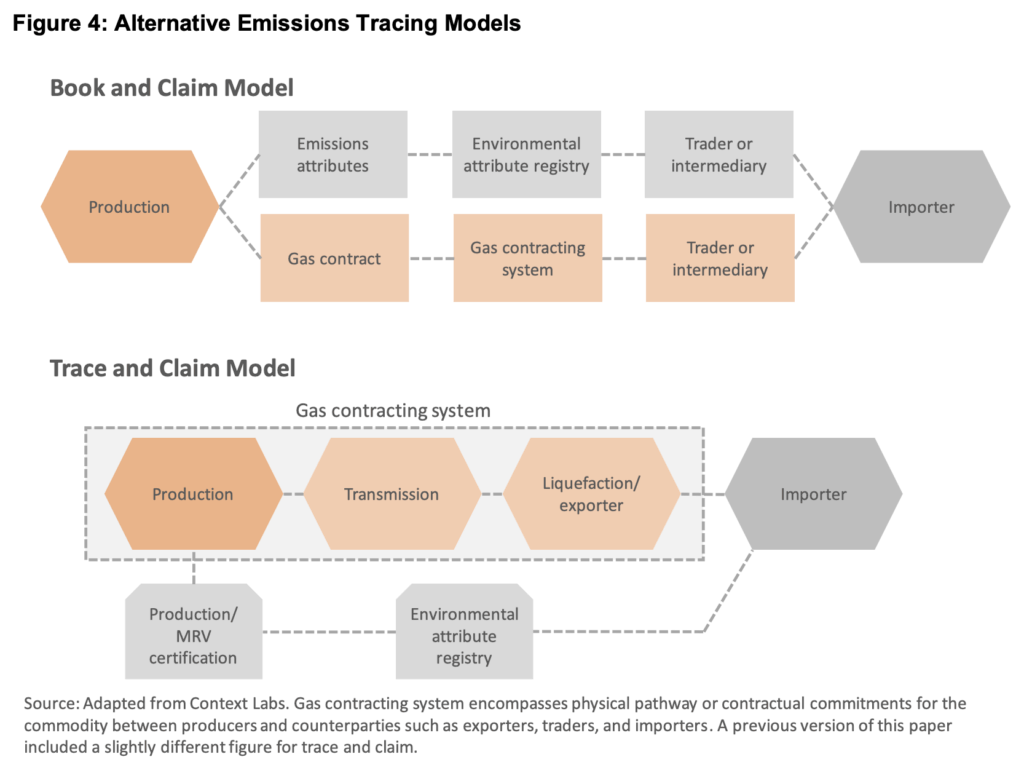
These two distinct methods of emissions traceability, referred to as trace-and-claim and book-and-claim, represent alternative models for associating emissions data with physical or contractual energy flows, and are actively discussed in the context of regulatory compliance and market implementation. Both traceability approaches are supported within the Context Labs AI-enabled platform. This flexibility allows industries to apply the traceability model most appropriate to their supply chains while maintaining data integrity, auditability, and transparency.
The EU Methane Regulation has been in discussion since August 2024 and requires companies involved in fossil fuel supply to monitor, report, and verify methane emissions at source level. The citation reflects the growing role of trusted data infrastructure in shaping how emissions performance is demonstrated under evolving regulatory frameworks.
Related
Nov 12, 2025
Differentiated Gas and the Chain of Custody
A Comparative Analysis of “Trace and Claim” and “Book and Claim” for Natural Gas Emissions Intensity. The widespread adoption of LNG transformed natural gas into a global commodity subject […]
Sep 24, 2025
Reimagining Emissions Transparency in the Energy Supply Chain
The global energy sector is at a turning point where emissions transparency is no longer of secondary concern, but a central driver of competitive commercial advantage and operational integrity. […]